


What Is Temperature and Pressure Compensation? A Full Breakdown of Its Critical Role in Measurement
2026-08-06 09:40What Is Temperature and Pressure Compensation? A Full Breakdown of Its Critical Role in Measurement
Introduction
Drawing on on-site commissioning experience from chemical and energy projects in Southeast Asia and South America, this paper centers on core application scenarios of temperature and pressure compensation for high temperature pressure transmitters, and dissects the core logic of temperature & pressure compensation. Real-time process parameters are collected via high temperature pressure transmitters and HART pressure transmitters to resolve distorted metering data and deviation issues in trade settlement for gas and steam media.

Can the instantaneous and cumulative values displayed on flowmeter screens be directly used for cost accounting and trade reconciliation? The answer is no. Pipeline temperature and operating pressure fluctuate continuously at industrial sites, causing synchronous changes in medium density. If only raw process flow data collected by high temperature pressure transmitters is adopted without temperature and pressure compensation, obvious deviations will exist in final statistical data.
Temperature and pressure compensation converts process flow and volume values measured on-site by high temperature pressure transmitters, HART pressure transmitters and industrial pressure transmitters uniformly into reference states specified by national and international standards, enabling horizontal and vertical comparison of metering data from different pipelines and equipment.
Though this function only consists of a set of parameter configurations inside instruments, it directly determines the accuracy of energy consumption statistics and trade settlement. For media such as natural gas and steam with drastic process fluctuations, high-precision metering is impossible if only flowmeters are installed without supporting industrial pressure transmitters and steam pressure transmitters to collect temperature and pressure signals.
I. Why Temperature and Pressure Compensation Is Mandatory for Industrial Metering
Temperature and pressure exert negligible impact on liquid media, while gas volume is highly sensitive to process pressure and temperature. For gas of identical mass, its volume shrinks under low temperature and high pressure, and expands sharply under high temperature and low pressure. Ordinary flowmeters only measure process volume, whereas standard volume or mass flow is required for factory energy consumption calculation and external sales settlement. Compensation calculation must be conducted with temperature and pressure signals collected by matched high temperature pressure transmitters.
Typical case of overseas chemical projects: When the pressure of the main compressed air pipeline rises from 0.6 MPa to 0.75 MPa and medium temperature increases from 25°C to 45°C, the monthly air consumption statistics show a difference over 12% compared with the air output of air compressors if ordinary flowmeters without temperature and pressure compensation are used. After synchronously collecting pressure and temperature via high temperature pressure transmitters and enabling the compensation function, data errors are greatly reduced.
Similar problems occur in pipelines conveying natural gas, nitrogen, carbon dioxide and saturated steam. Single flow signals fail to realize accurate metering for pipe networks with fluctuating process conditions, so a temperature & pressure compensation metering system must be built with industrial pressure transmitters and steam pressure transmitters.
II. Two Types of Measurement Errors Resolved by Temperature Compensation
Medium thermal expansion and cold contraction: Gas density drops as temperature rises. If only process volume measured by high temperature pressure transmitters is adopted, volume variations caused by temperature will be counted as actual consumption.
Instrument temperature drift: Built-in sensors and transmission circuits of HART pressure transmitters and high temperature pressure transmitters generate zero drift along with temperature changes, with more prominent drift errors in low-end instruments.
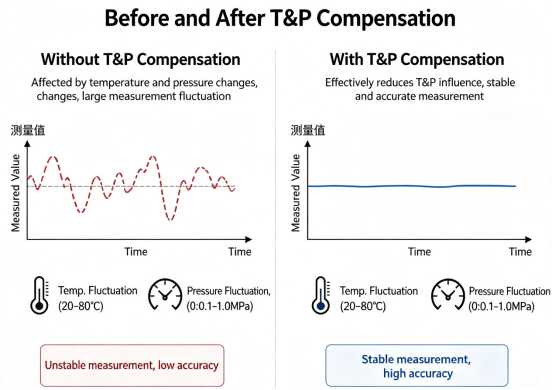
On-site installation specifications require temperature measuring points to be close to the pressure tapping ports of high temperature pressure transmitters and avoid heat exchange dead zones, so that measured temperature values can truly match the medium. Otherwise, metering results will still be distorted even with well-developed compensation algorithms.
III. Core Points of Pressure Compensation: Absolute Pressure Must Be Adopted
Pressure compensation corrects changes in gas density induced by pressure fluctuations; the higher the pipeline pressure, the greater the mass per unit gas volume. Most high temperature pressure transmitters and steam pressure transmitters output gauge pressure, and local standard atmospheric pressure must be superimposed for compensation calculation:
Absolute Pressure = Gauge Pressure + Local Atmospheric Pressure
Case of fertilizer projects: When the pipeline gauge pressure is 0.6 MPa and atmospheric pressure is 0.101325 MPa, the effective absolute pressure input to the compensation algorithm of high temperature pressure transmitters is 0.701325 MPa. If gauge pressure is directly used for calculation, the monthly settlement difference can reach 8%. This fault is concealed with normal instrument curves and can only be discovered during reconciliation. When selecting and matching industrial pressure transmitters, it is necessary to clarify whether the output is absolute pressure or parameter conversion is required.
IV. Basic Calculation Logic of Temperature and Pressure Compensation
Gas compensation is based on the ideal gas equation PV=nRT, with the conversion formula:
Qₙ = Q × P / Pₙ × Tₙ / T
Parameters Definition
Qₙ: Standard condition flow
Q: Process flow (output from differential pressure elements matched with high temperature pressure transmitters)
P: Absolute medium pressure
Pₙ: Standard pressure
T: Medium temperature in Kelvin
Tₙ: Standard temperature
Mandatory requirement: Celsius temperature must be converted to Kelvin: T (K) = t (°C) + 273.15. A common low-level error during on-site commissioning of high temperature pressure transmitters and HART pressure transmitters is directly inputting Celsius temperature values.
For natural gas and high-pressure steam metering scenarios, the general formula is only used for principle explanation. Professional totalizers matched with high temperature pressure transmitters and steam pressure transmitters adopt special algorithms with compressibility factors to meet foreign trade settlement standards.
V. Composition of a Complete Temperature & Pressure Compensation Metering System
A set of compliant metering equipment contains four signal acquisition units, all selected from the keyword list for regional promotion:
Flow signal: Differential pressure elements cooperate with high temperature pressure transmitters to output original process signals;
Temperature signal: Temperature transmitters collect real-time medium temperature for correction;
Pressure signal: Industrial pressure transmitters, steam pressure transmitters and HART pressure transmitters collect pipeline absolute pressure to complete density compensation;
Calculation unit: Intelligent totalizers and DCS systems read signals from high temperature pressure transmitters to finish conversion, accumulation and remote data upload.
Six items to check during on-site commissioning: matched temperature & pressure measuring ranges, clear distinction between gauge pressure and absolute pressure, unified standard condition parameters, consistent flow units, adjustable damping for weak signals, and enabled breakage alarm functions. Most metering deviations are not caused by hardware damage, but accumulated offsets resulting from mixed use of parameter units in high temperature pressure transmitters and HART pressure transmitters.
VI. Main Working Conditions Requiring Supporting Temperature and Pressure Compensation
Natural gas trade: Pipeline pressure fluctuates drastically, and combined compensation with steam pressure transmitters and high temperature pressure transmitters is standard configuration for stations;
Compressed air energy consumption control: High temperature pressure transmitter flow data combined with industrial pressure transmitters is used to identify pipeline leakage;
Steam thermal energy metering: The density of saturated steam changes drastically with temperature, and HART pressure transmitters matched with high temperature pressure transmitters convert mass and heat values;
Chemical process gas: Steam pressure transmitters cooperate with high temperature pressure transmitters to guarantee data accuracy for proportion calculation of hydrogen, carbon dioxide and other media;
Environmental flue gas monitoring: Static pressure of flue gas is collected by industrial pressure transmitters, which together with flow data from high temperature pressure transmitters are converted into standard condition emission values.
VII. Common Pitfalls During On-site Commissioning
Only flowmeters are installed without matched high temperature pressure transmitters and industrial pressure transmitters; no temperature and pressure signals available for settlement;
Excessive distance between temperature & pressure measuring points and pressure tapping ports of high temperature pressure transmitters; pressure reduction via valves leads to untrue collected medium parameters;
Insufficient insertion depth of temperature sleeves causes delayed temperature measurement and distorted compensation curves matched with high temperature pressure transmitters;
No distinction between process flow and standard condition flow; original data from high temperature pressure transmitters is mixed in reports;
Built-in compensation inside flowmeters overlaps with secondary compensation via DCS based on signals from high temperature pressure transmitters, leading to severely distorted data;
No alarm for broken temperature and pressure signals; faulty parameters from high temperature pressure transmitters are continuously accumulated.
VIII. Calibration Methods for Temperature & Pressure Compensation Systems
Single-point comparison: Handheld devices verify real-time temperature and pressure values of high temperature pressure transmitters and HART pressure transmitters to confirm measuring ranges and wiring connections;
Logic verification: Under identical process conditions, the converted standard condition flow from high temperature pressure transmitters rises synchronously as pressure increases. If the logic is reversed, atmospheric pressure parameters shall be checked;
Data cross-check: Air output of compressors matches cumulative flow data from high temperature pressure transmitters; natural gas data reconciles with settlement data from steam pressure transmitters at stations;
Abnormality observation: Commissioning is qualified only if no abrupt spikes appear on the flow curves of high temperature pressure transmitters during equipment startup and shutdown.
IX. Conclusion
Temperature and pressure compensation is the core technology for accurate metering of gas and steam. The complete metering system takes high temperature pressure transmitters as the core, with industrial pressure transmitters, HART pressure transmitters and steam pressure transmitters supporting the collection of temperature and pressure parameters. Metering accuracy does not depend on instrument brands, but standardized full-process management including transmitter measuring point layout, parameter unit configuration and compensation algorithms. Matching transmitters and setting compensation parameters in a standardized manner enables flow data to support energy consumption statistics and trade reconciliation; chaotic configuration of transmitter parameters will lead to numerous unexplainable differences during monthly reconciliation.