



Auto Instrument | How Pressure Transmitters Sense Pressure: Principles, Signals and Troubleshooting
2026-10-26 10:53Auto Instrument | How Pressure Transmitters Sense Pressure: Principles, Signals and Troubleshooting
Introduction
Drawing on practical on-site maintenance experience, the technical team of Auto Instrument breaks down the full conversion process through which pressure transmitters detect pressure. It helps maintenance engineers understand the internal working logic of instruments and build clear troubleshooting routines when encountering abnormal pressure readings, zero drift and output fluctuations.
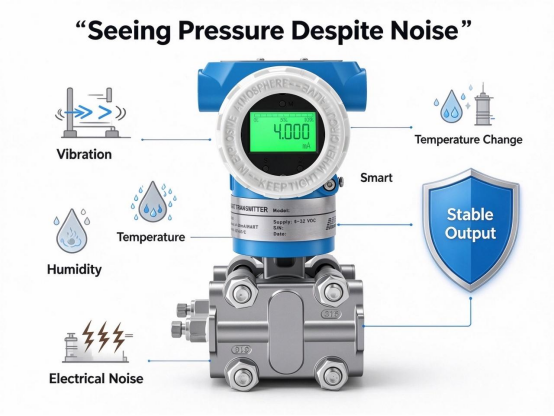
Technicians new to pressure transmitters often wonder what component inside the instrument senses pressure inside the pipeline. The pressure value displayed in the control room goes through a complete set of physical and signal conversion processes. Mastering this full workflow will make on-site fault handling more systematic.
1. How Pressure Acts Inside the Transmitter
The essence of industrial pressure measurement is to transmit medium pressure to sensitive sensing components. Basic pressure formula: $\boldsymbol{(\boldsymbol{P=F/A})}$ Pressure = Force ÷ Area of force. Under the same applied force, different force-bearing areas yield different pressure values.
Industrial pressure transmitters receive mechanical pressure from pipelines and storage tanks via process connections. The core internal components are sensing elements, commonly including metal diaphragms, ceramic diaphragms, strain gauges and various elastic measuring components. Take the widely used diaphragm structure as an example: medium pressure acts on the diaphragm surface and causes tiny, invisible deformation. Deformation increases as pressure rises, and the diaphragm resets when pressure drops. The instrument captures this deformation to realize pressure measurement. Steam pressure transmitters used on boilers and thermal pipelines also rely on diaphragm deformation for pressure acquisition. For high-temperature working conditions, the heat resistance of components must be carefully evaluated to meet the requirements of high-temperature pressure transmitters.
2. Three Mainstream Sensing Principles for Detecting Deformation
Transmitters of different models adopt different internal sensing principles. Three types are widely used in field applications: piezoresistive, capacitive and resonant.
Piezoresistive Pressure Transmitter It leverages the property that material resistance changes under compression. Medium pressure deforms the diaphragm; internal piezoresistive elements are stressed and their resistance changes accordingly. The circuit board captures resistance signals, performs amplification and temperature compensation calculation, and outputs corresponding measurement signals. This structure is widely used in hydraulic systems and ordinary process pipeline measurement. Damage to the sensor chip is also a common cause of on-site faults.
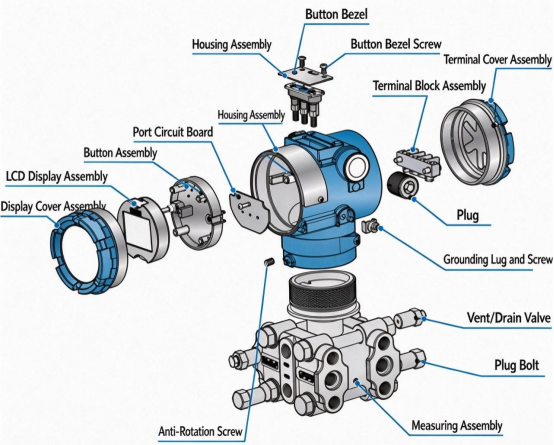
Capacitive Pressure Transmitter It relies on changes in electrode spacing to alter capacitance. Two sets of electrodes are fitted inside. Pressure displaces the measuring diaphragm, changing the distance between electrodes and the capacitance synchronously. The circuit module reads capacitance variation and converts it into pressure values. Capacitive pressure transmitters of this type are often selected for high-precision measurement scenarios in petrochemical and power industries.
Resonant Pressure Transmitter Mechanical stress induced by pressure changes the natural vibration frequency of resonant elements. The circuit reads frequency shifts and converts them into pressure readings. It is mostly applied in working conditions requiring stringent long-term stability.
3. Why 4 20mA Is the Common Output, and Smart Versions Support HART
Most field transmitters connect to DCS, PLC or digital display instruments. 0 MPa corresponds to 4 mA, and full scale corresponds to 20 mA. The key reason for not using 0 20mA is fault identification. If the zero point is 0 mA, a broken wire also outputs 0 mA, and the control system cannot distinguish whether the process pressure has dropped to zero or there is a line fault. With a 4 mA zero point, the loop still maintains 4 mA when no pressure is applied. If the cable is disconnected, the current drops close to 0, so the control system can directly identify loop abnormalities. Meanwhile, current signals are less susceptible to wire resistance interference, supporting long-distance industrial transmission. Even so, shielding, grounding and wiring layout must be properly managed to avoid electromagnetic interference. Many smart pressure transmitters support superimposed digital communication. Operators can modify ranges and read instrument diagnostic status via a hand communicator.
4. Gauge, Absolute and Differential Pressure — Different Reference Datums
Pressure measurement is divided into gauge pressure, absolute pressure and differential pressure, differentiated mainly by their reference pressure datum.
· Gauge pressure: Referenced to local atmospheric pressure. It is adopted for most pipeline and equipment measurement on site.
· Absolute pressure: Referenced to perfect vacuum. Absolute pressure = gauge pressure + local atmospheric pressure. Absolute pressure transmitters are used for vacuum, distillation processes, vacuum systems and gas process calculation.
· Differential pressure: $\boldsymbol{\Delta P=P1-P2}$. It measures the pressure difference between two points. It is used for detecting filter clogging and orifice plate flow measurement.
5. Priority Troubleshooting Steps for Inaccurate Pressure Readings
Abnormal measurement does not always mean the transmitter itself is damaged. Troubleshoot from outside to inside in the following order:
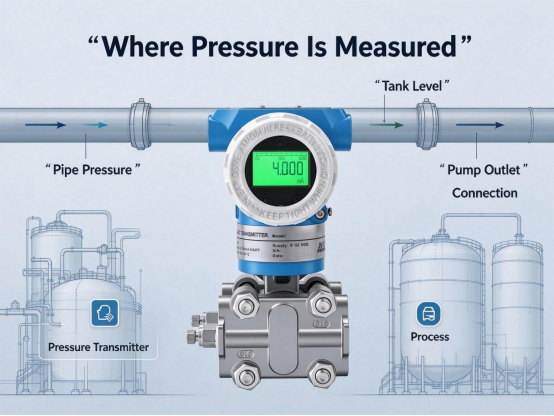
1. Pressure tap and impulse piping: Gas accumulation in impulse tubes for liquid service, clogged taps for impurity-laden media and incorrect opening/closing of primary valves all lead to signal distortion. Check taps, trapped gas in impulse lines and valve status.
2. Temperature interference: Heat transferred from high-temperature media to the instrument alters the characteristics of sensing elements and causes zero drift. High-temperature applications require siphon loops, condensate pots and heat insulation measures to match the allowable medium temperature of the instrument.
3. Genuine process pressure fluctuation: Pressure pulsation inherently exists at pump outlets, compressor outlets and downstream of valves, causing transmitter output to fluctuate. It is necessary to distinguish real process oscillation from impact damage to the instrument.
4. Range matching: Excessive range margin, for example, a 0 10 MPa transmitter used for an actual operating pressure of only 0.3 MPa, will limit measurement performance in the low-pressure section. The selected range should match the actual process interval.
6. Key Selection Points for Pressure Transmitters
Besides the measuring range, evaluate the following conditions comprehensively:
1. Measurement range: Cover normal operation, startup and surge pressure;
2. Accuracy class: Verify accuracy definitions from the manufacturer datasheet;
3. Overpressure resistance: Withstand instantaneous pressure surges;
4. Wetted material: Diaphragm material compatible with corrosive media;
5. Service conditions: Explosion protection, high temperature, humidity and other environmental requirements.
7. Summary
Complete signal chain of a smart pressure transmitter: Medium pressure deforms the diaphragm → sensor captures tiny variations → circuit board performs calculation and conversion → 4 20mA signal is uploaded to the control system → pressure reading is displayed in the control room.
On-site troubleshooting should not focus only on the transmitter body. Pressure taps, impulse piping, installation, parameter settings and signal cables all form part of the full pressure measurement system. As a pressure instrument manufacturer, Auto Instrument supplies absolute pressure transmitters, steam pressure transmitters, high-temperature pressure transmitters and capacitive pressure transmitters for a wide range of process conditions. Proper evaluation of medium, temperature and explosion-proof requirements during selection greatly reduces maintenance failures in later operation. Mastering the working principle streamlines transmitter selection, installation and fault handling.