


Auto Instrument | Agitation Is More Than Just Stirring Materials: A Complete Guide to Agitation Principles & Types
2026-10-26 10:18Auto Instrument | Agitation Is More Than Just Stirring Materials:
A Complete Guide to Agitation Principles & Types
Introduction
Combined with actual working conditions of chemical reaction tanks, the technical team of Auto Instrument analyzes the working logic of agitation equipment and corrects the misconception that “higher rotating speed equals better mixing performance”. This guide helps process and equipment engineers understand agitation principles and properly select impellers and operating parameters.
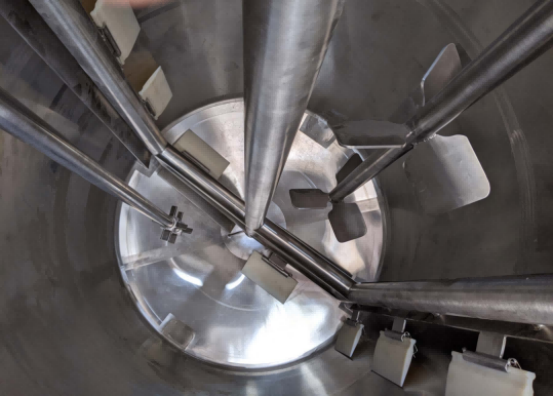
Many on-site teams have encountered this issue: obvious vortexes appear in the stirring tank, yet sediment still accumulates at the tank bottom. After increasing the rotation speed, the motor current keeps rising, but uneven mixing of materials is not improved. Impeller structure, installation height, material viscosity and flow pattern inside the tank directly determine the agitation performance. Even with identical motor power and rotation speed, impellers of different designs can generate vastly different flow states.
1. Process Functions of Agitation Equipment
Agitation drives material flow via mechanical rotation, gas sparging or liquid jetting to achieve sufficient contact between multi-phase materials, so as to complete mixing, dispersion, heat transfer and mass transfer processes. Common process objectives are listed as follows:
· Liquid mixing: Eliminate concentration differences inside the tank through fluid circulation;
· Solid suspension: Drive liquid flow to prevent sedimentation and accumulation of solid particles;
· Liquid-liquid dispersion: Break one liquid into tiny droplets and disperse them in another liquid by shear force;
· Gas-liquid dispersion: Shatter bubbles to expand the contact area between gas and liquid;
· Heat and mass transfer: Continuous circulating flow of materials improves heat exchange and mass transfer efficiency.
Different process objectives have different fluid requirements. Liquid mixing prioritizes circulating flow rate; solid suspension focuses on flow velocity at the tank bottom; liquid-liquid dispersion requires sufficient local shear strength. For many reactor processes, measurement instruments are deployed alongside the agitation system to monitor material conditions in real time. For slurry applications, slurry density meters are adopted in some projects. Chemical density meters are frequently paired with stirring tanks for synthesis and batching procedures. As a density meter manufacturer, we have seen numerous field cases where agitation performance directly affects sampling and measurement stability of industrial online liquid density meters and liquid density meters.
2. Main Types of Agitation
By driving source, agitation is divided into three categories: mechanical agitation, gas agitation and jet agitation. Mechanical agitation uses a motor to drive impeller rotation. Common impeller types include paddle, propeller, turbine, anchor and helical ribbon.
1. Paddle Agitator Consists of a stirring shaft and blades, including flat-blade, inclined-blade and pitched paddle types. It features a simple structure and convenient disassembly & maintenance, suitable for dissolution, batching and liquid mixing of low-to-medium viscosity materials.
2. Propeller Agitator With a propeller-style impeller, it generates strong axial flow. Liquid is pushed axially and then refluxes to form large-scale circulation. It fits low-viscosity liquid mixing, dissolution and conventional solid suspension applications.
3. Turbine Agitator Multi-blade structure, including straight-blade turbine, inclined-blade turbine and disk turbine. Straight-blade disk turbine mainly produces radial flow; inclined-blade turbine delivers combined axial and radial flow. Its conveying and shear capacity is determined by blade angle and structure.
4. Anchor Agitator Blades run close to the inner tank wall with a large stirring diameter and low operating speed, mainly acting on materials around the tank wall. Higher viscosity demands higher torque output from the stirring shaft, so sufficient margin shall be reserved for motor and reducer load.
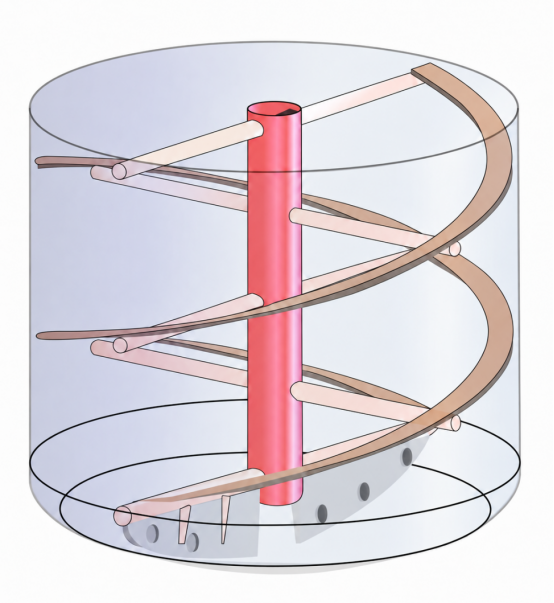
5. Helical Ribbon Agitator Spiral blades are arranged along the axial direction. Rotation pushes materials to move axially, and circulation is formed with reflux inside the tank. It is widely used for high-viscosity material agitation.
6. Gas Agitation Compressed gas enters the liquid phase through gas distribution devices. Rising bubbles drive liquid circulation while realizing gas-liquid mass transfer.
7. Jet Agitation Pressurized fluid is sprayed out through nozzles by a circulating pump, entraining surrounding media to achieve tank circulation. Nozzle angle, circulating flow rate and pipeline loss directly affect agitation results. For media containing solid particles, risks of nozzle wear and blockage shall be evaluated in advance.
3. Core Flow Field Principles of Agitation
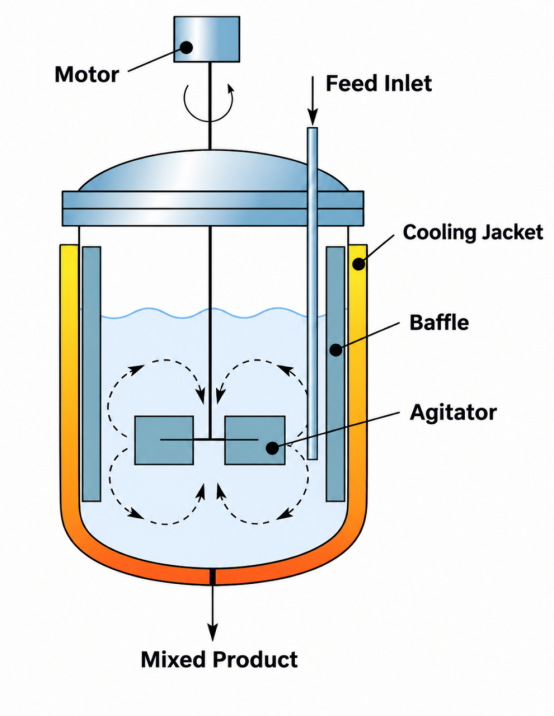
Mechanical agitation transfers mechanical energy from the impeller to materials, forming three flow patterns: axial flow, radial flow and tangential flow. Usually multiple flow fields overlap and coexist inside the tank.
1. Axial Flow Materials move up and down along the stirring shaft to form large circulation inside the tank, enabling material exchange at different heights. It has strong overall conveying capacity, ideal for liquid mixing, solid suspension and heat transfer scenarios.
2. Radial Flow Liquid is thrown from the impeller toward the tank wall, rebounds upward and downward after hitting the wall and flows back to the impeller. Impellers generating radial flow deliver strong local shear and turbulence, more suitable for droplet and bubble dispersion processes.
3. Tangential Flow Materials rotate circumferentially around the stirring shaft. Excessive tangential flow creates surface vortexes, where materials spin as a whole with little vertical exchange. Installing baffles on the tank wall can effectively suppress tangential rotation and improve overall circulation.
In actual tanks, axial, radial and tangential flow exist simultaneously. Flow intensity is determined by impeller type, installation position and tank accessories.
4. Relationship Between Rotation Speed and Agitation Power
Impeller diameter, rotation speed and material properties all change power consumption of agitation. Under turbulent conditions, the shaft power formula is: P = Np × ρ × n³ × D⁵ P — Impeller shaft power (W) Np — Power number (dimensionless) ρ — Liquid density (kg/m³) n — Impeller rotation speed (r/s) D — Impeller diameter (m)
With fixed impeller structure, tank and material, the power number is approximately constant. Agitation power is proportional to the cube of rotation speed. Changing impeller diameter also drastically alters power consumption. The power number varies for different structures and requires targeted calculation. Higher rotation speed is not always better. Excessively high speed may lead to liquid surface air entrainment, foaming, equipment vibration and motor overload. This formula only calculates impeller shaft power. Motor selection shall also account for transmission loss and actual operating load.
5. Selection Logic for Agitators
Three basic conditions shall be confirmed first for selection: material characteristics, process agitation objectives and reactor structure. Impeller type, size and operating parameters are all determined according to actual working conditions, with comprehensive consideration of material viscosity, density, solid content, tank dimension and required mixing performance. It is worth noting that agitation status directly affects online measurement instruments. Over-intense agitation causes measurement disturbance, while insufficient agitation leads to material stratification; both interfere with reading stability of online density meters and similar instruments.
6. Conclusion
Paddle and propeller impellers excel at liquid circulation and mixing; turbine impellers suit liquid-liquid and gas-liquid dispersion; anchor and helical ribbon impellers are mainly used for high-viscosity material processing. The actual performance of agitation equipment cannot be judged solely by motor rotation speed and operating current. It shall be evaluated comprehensively based on material properties, impeller layout and process test results.
As a density meter manufacturer, Auto Instrument supplies online density meters, liquid density meters, industrial online liquid density meters, slurry density meters and chemical density meters. These products match various stirring reactors for real-time material detection in process flow, helping process engineers monitor material conditions inside tanks.